
Why posture has quietly become one of the biggest health challenges facing today’s families.
Walk into almost any Calgary coffee shop, hockey arena or school gym and you’ll notice something curious. It isn’t just teenagers looking down at their phones anymore. Parents are doing it. Grandparents are doing it. Even toddlers seem remarkably skilled at bending their necks toward a tablet.
We’ve become a society that’s constantly looking down.
As a chiropractor with advanced training in posture correction and mind-body medicine, I spend my days helping people understand why they’re experiencing headaches, neck pain, stiffness or fatigue. Many believe the problem appeared overnight—that they slept wrong, lifted something heavy or simply “got older.”
Often, the story began years earlier, one small habit at a time.
Poor posture has quietly become one of the most significant health challenges facing families today, and because it develops gradually, many of us don’t notice it until our bodies begin asking for attention.
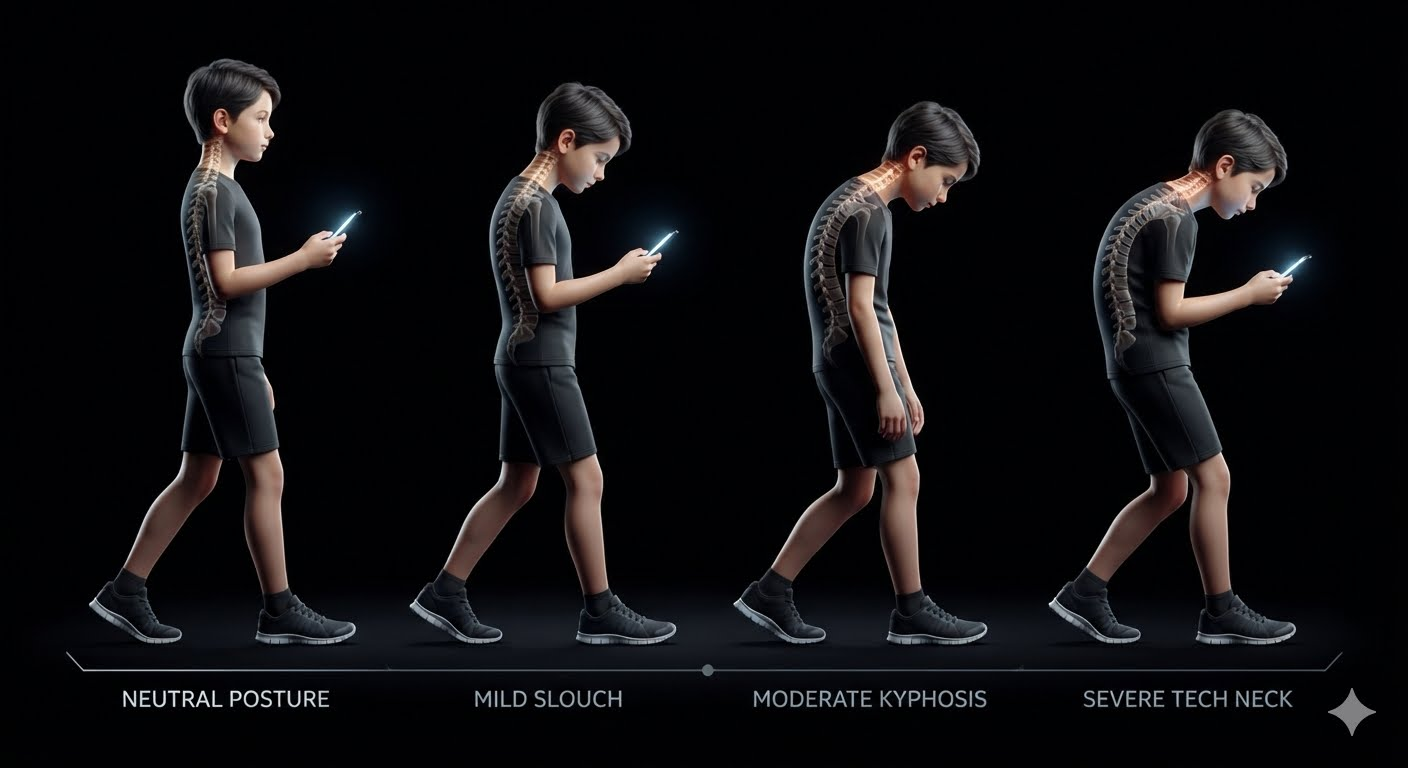
The New Normal…That Isn’t Normal
Our bodies were designed for movement.
For thousands of years, humans walked, climbed, reached, squatted and explored the world upright. Today, many of us spend hours sitting at desks, driving, studying or scrolling through screens. Children often finish a full day at school only to head home for homework, gaming or social media.
Technology itself isn’t the problem. It has transformed how we learn, communicate and work. The challenge is that our bodies haven’t evolved nearly as quickly as our devices have.
Our spines still expect us to move.
A Young Hockey Player’s Story
One patient I’ll never forget was a 12-year-old hockey player whose parents brought him in because of frequent headaches. Like many active Calgary families, they assumed hockey was to blame.
But as we talked, another pattern emerged.
Between school, studying and time on his phone, he was spending far more hours each day with his head bent forward than he was skating.
Over time, his neck had become strained and the muscles supporting his head were working overtime. As we focused on improving his posture, restoring movement and reducing stress on his neck, his headaches became far less frequent.
His story isn’t unusual anymore. In fact, it’s becoming increasingly common.
More Than Looking Good
When most people hear the word posture, they think about standing up straight or looking confident in a family photo.
Posture is about much more than appearance.
Your brain depends on a constant stream of information from your muscles and joints to understand where your body is in space. Think of it like your body’s GPS. When we spend months or years in the same rounded positions, the muscles and joints of the neck, back and hips often must work harder than they were designed to.
That extra strain doesn’t guarantee pain, but over time it can contribute to headaches, neck discomfort, back pain and reduced mobility.
It’s one of the reasons I encourage people to think of posture as a window into how well the body is adapting to everyday life.
Small Habits Shape Big Outcomes
The encouraging news is that posture isn’t determined by genetics alone.
It’s shaped by habits.
- How we hold our phones.
- How often we get up and move.
- How we carry a backpack.
- Whether we spend time climbing, running, walking and playing.
Just as poor posture develops gradually, healthy posture can be rebuilt through small, consistent choices.
Calgary Families Have an Advantage
One of the things I love most about living in Calgary is that we’re naturally an active community. Whether it’s skating at the neighbourhood rink, hiking in Kananaskis, skiing in the Rockies or walking along the Bow River, opportunities to move are everywhere.
Movement is one of the greatest gifts we can give our bodies.
The challenge is making sure our daily habits between those adventures don’t quietly undo all the good we’re doing.
At Glow, we often talk about enhancing the human experience. To me, that’s what better posture is really about. It’s not simply about reducing aches and pains. It’s about breathing more freely, moving more comfortably, playing with your children, exploring the outdoors and saying “yes” to the moments that make life memorable.
Stand Tall Challenge
This month, try one simple family habit.
Every time someone notices they’re looking down at a phone or tablet, everyone joins in.
- Stand up.
- Roll your shoulders back five times.
- Take three slow, deep breaths.
Then carry on with your day.
It takes less than thirty seconds, but repeated often enough, it becomes a reminder that our bodies were designed to move—not remain frozen in one position.
Looking Ahead
Over the coming months, we’ll explore why posture affects much more than aches and pains, how technology is reshaping childhood, why posture and confidence are more closely connected than most people realize, and simple ways every family can build healthier habits together.
Because standing taller isn’t about perfection.
It’s about giving ourselves—and the next generation—the opportunity to experience life with greater comfort, confidence and joy.
Sometimes the biggest changes begin with something as simple as lifting our eyes, taking a deep breath and standing just a little taller.